
CPI Protocol · Cellular Activation
Hyperbaric Oxygen Therapy and Stem Cell Treatment: How HBOT Accelerates Healing and Recovery
The science behind the combination is compelling, the results patients report are remarkable, and the biological mechanisms are now well-documented in peer-reviewed research.
8×
Increase in circulating stem cells after 20 HBOT sessions
5-Day
Integrated treatment protocol at CPI
1.5–3×
Normal atmospheric pressure inside the medical-grade chamber
Medically reviewed by Dr. Mariela Carranza, MD — Cellular Performance Institute
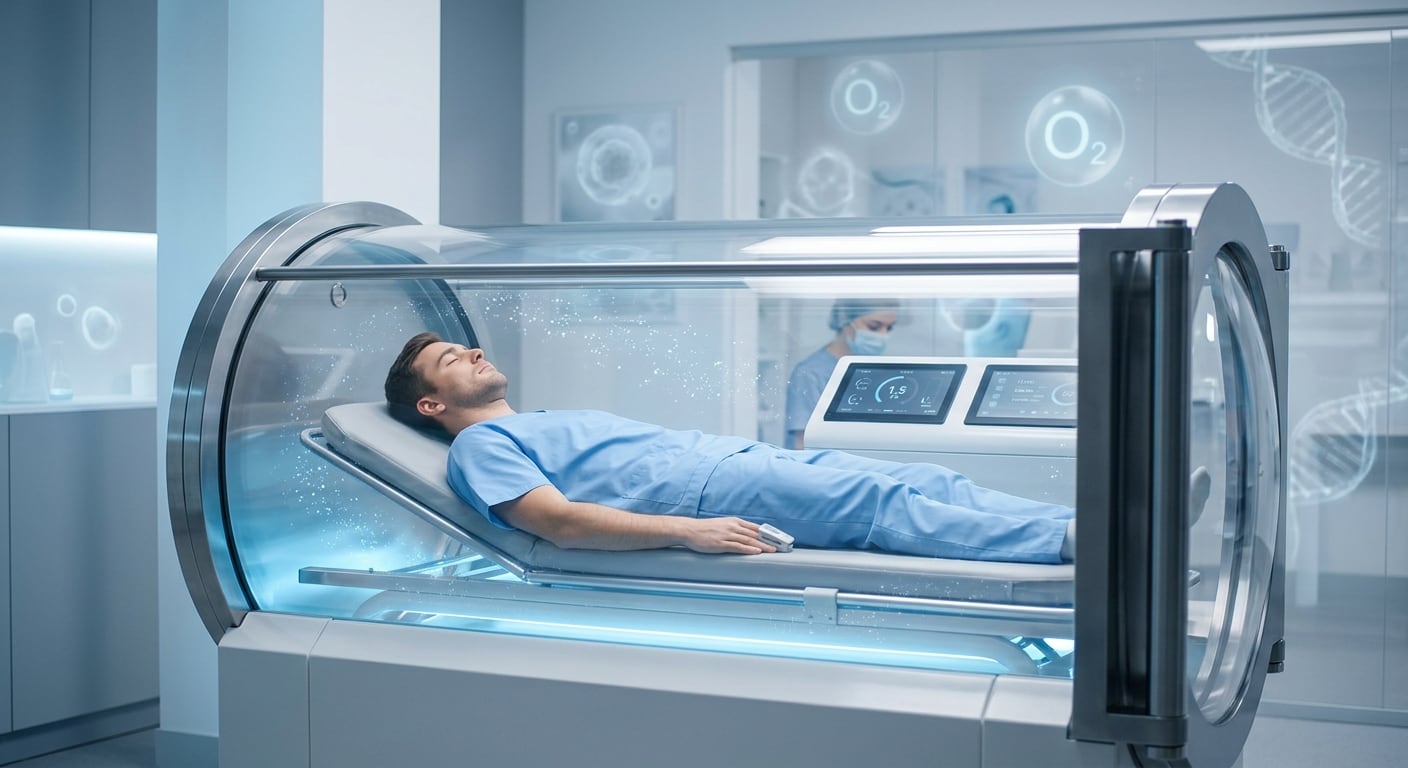
If you’ve been researching stem cell therapy, you’ve probably encountered the term HBOT — hyperbaric oxygen therapy. More and more leading regenerative medicine clinics are pairing these two treatments together, and for good reason. The science behind the combination is compelling, the results patients report are remarkable, and the biological mechanisms are now well-documented in peer-reviewed research.
At the Cellular Performance Institute (CPI), HBOT is a core component of our 5-day treatment protocol — not an add-on, not a luxury upgrade, but a clinically integrated step in what we call cellular activation: the process of preparing your body’s environment so that the stem cells we administer can do their most effective work.
This article explains exactly what HBOT is, what it does at the cellular level, and why combining it with stem cell therapy produces outcomes neither treatment achieves as powerfully on its own.
The Basics
What Is Hyperbaric Oxygen Therapy?
Hyperbaric oxygen therapy involves breathing 100% pure oxygen inside a pressurized chamber, typically at 1.5 to 3 atmospheres absolute (ATA) — meaning the air pressure inside the chamber is 1.5 to 3 times greater than normal atmospheric pressure.
Under these conditions, oxygen dissolves directly into your blood plasma, cerebrospinal fluid, and lymphatic fluid — not just into red blood cells as it does under normal pressure. This means oxygen reaches tissues that have compromised circulation, areas where blood flow is restricted by injury, inflammation, chronic disease, or aging. Tissues that have been starved of oxygen suddenly receive a concentrated, pressurized supply.
The result is a cascade of biological responses that go far beyond simply “oxygenating” tissue. HBOT activates repair pathways at the molecular level — and one of the most important of those pathways directly involves your stem cells.
Peer-Reviewed Research
The Science: How HBOT Mobilizes Your Body’s Stem Cells
This is where the research gets genuinely exciting — and where the combination of HBOT and stem cell therapy becomes more than the sum of its parts.
In a landmark study published in the American Journal of Physiology — Heart and Circulatory Physiology, researchers at the University of Pennsylvania’s Institute for Environmental Medicine demonstrated that HBOT mobilizes stem and progenitor cells from the bone marrow through a nitric oxide-dependent mechanism. After a single HBOT session, circulating CD34+ stem cells in the bloodstream doubled. After a course of 20 sessions, those cells increased eightfold. (Thom et al., 2006 — PubMed)
Here is the mechanism, explained step by step:
1
Nitric oxide production
When the body is exposed to hyperbaric oxygen, endothelial nitric oxide synthase (eNOS) in bone marrow stromal cells is activated. This triggers a sharp rise in nitric oxide (NO) concentration within the bone marrow itself — the same signaling molecule that governs vascular tone, blood flow regulation, and cellular repair signaling.
2
Stem cell release
The elevated nitric oxide activates matrix metalloproteinase-9 (MMP-9), an enzyme that cleaves stem cell factor (SCF) from its membrane attachment point in the bone marrow. This releases stem and progenitor cells from their bone marrow niche into the bloodstream, where they can circulate freely and home to areas of injury or inflammation.
3
Vascular growth factor activation
The mobilized stem cells express high levels of receptors for vascular endothelial growth factor (VEGF) and stromal-derived factor-1 (SDF-1). These signaling proteins act as a homing beacon — drawing the newly mobilized stem cells toward damaged tissue that needs repair. A comprehensive review published in Antioxidants and Redox Signaling (Thom, 2011) confirmed that HBO₂ increases VEGF synthesis in soft tissue wounds and activates vasculogenic stem cells, enhancing the formation of new blood vessels in healing tissue. (PMC Full Text)
4
Enhanced engraftment potential
A follow-up clinical study published in PMC examined 20 patients across two HBOT protocols (2.0 ATA and 2.5 ATA) and found that mobilized CD34+ stem cells contained significantly elevated levels of hypoxia-inducible factors (HIF-1, HIF-2, HIF-3) and thioredoxin-1 — regulatory proteins that improve stem cell engraftment and differentiation once the cells reach their target tissue. In other words, HBOT doesn’t just release more stem cells — it primes them to perform better. (Thom et al., 2014 — PMC)
The practical implication is profound: HBOT essentially recruits your own body’s repair army and sends it to exactly where it is needed.
CPI Protocol
What Is “Cellular Activation” — and Why Does It Matter?
At CPI, we use the term cellular activation to describe the biological state we are working to create before, during, and after stem cell administration. It is not just a marketing phrase — it reflects a specific physiological objective.
Stem cells do not work in isolation. They respond to the biochemical environment around them. If that environment is inflamed, hypoxic (oxygen-deprived), or lacking in the signaling molecules that direct cellular repair, even high-quality stem cells will underperform. They may not migrate to the right locations. They may not differentiate into the tissue types needed. They may not survive long enough to complete their repair work.
HBOT changes that environment. By elevating oxygen tension in tissues, stimulating VEGF and SDF-1 production, mobilizing endogenous stem progenitor cells from the bone marrow, and reducing systemic inflammation, HBOT creates conditions in which administered stem cells can engraft more effectively, differentiate more reliably, and sustain their activity longer.
This is why HBOT is integrated into CPI’s 5-day treatment protocol — not scheduled around stem cell administration, but coordinated with it. The sequencing matters. The timing matters. The protocol is designed to maximize the window of cellular activation so that every stem cell we administer enters an environment optimized for repair.
Beyond the Headlines
Why Patients and Biohackers Are Paying Attention
You may have heard about HBOT from Joe Rogan, who has discussed it extensively on his podcast as part of his personal performance and recovery stack. Or from Andrew Huberman, who has explored the neuroscience of oxygen and pressure in the context of brain health and cellular repair. Both have helped bring HBOT into mainstream awareness — and the interest they’ve generated has led a lot of people to ask deeper questions about what HBOT is actually doing at the cellular level.
The answer, as the research above shows, is considerably more sophisticated than simply “more oxygen = faster healing.” HBOT is a molecular intervention. It activates gene expression, modulates growth factor signaling, recruits stem cells from bone marrow, and reshapes the tissue environment in ways that directly enhance the effectiveness of regenerative therapies.
That is why serious biohackers, elite athletes, and patients dealing with complex chronic conditions are not just experimenting with HBOT on its own — they are seeking protocols that combine HBOT with stem cell therapy in a clinically coordinated way. That combination is exactly what CPI offers.
The Experience
What to Expect During HBOT at CPI
HBOT sessions at CPI take place inside a comfortable, medical-grade hyperbaric chamber that seats 8 people. Here is what the experience typically looks like:
Before the Session
Preparation
You change into 100% cotton clothing (synthetic fibers are not permitted in the chamber due to oxygen safety protocols). You remove any jewelry, watches, or electronic devices.
During the Session
In the Chamber
The chamber pressurizes gradually over approximately 10 to 15 minutes. Most patients describe a sensation similar to the pressure change when descending in an airplane — a mild fullness in the ears that clears easily with swallowing or yawning. Once at treatment pressure, you breathe normally. Sessions typically last 60 minutes. Many patients read, rest, or simply relax.
After the Session
Recovery
You may feel a mild sense of calm or mental clarity — a commonly reported effect linked to the normalization of nitric oxide signaling and improved cerebral oxygenation. Some patients feel pleasantly fatigued, similar to the feeling after a long, restorative sleep. This is normal and typically resolves within a few hours.
Across CPI’s 5-day protocol, HBOT sessions are timed to work in concert with stem cell administration — creating the cellular activation window described above and sustaining it throughout your treatment stay.
Patient Profile
Who Is HBOT Combined with Stem Cell Therapy For?
CPI treats patients from across the United States, Canada, and internationally. Patients who pursue our combined HBOT and stem cell protocol typically fall into one of several categories:
Athletes and active individuals recovering from orthopedic injuries, joint degeneration, or sports-related tissue damage who want faster, more complete recovery
Patients with autoimmune conditions seeking to modulate immune dysregulation through regenerative mechanisms
Individuals with neurological concerns, including post-concussion syndrome, early cognitive decline, or neuropathy
Anti-aging and longevity patients who want to proactively address cellular decline and optimize biological age
Biohackers and performance optimizers who have exhausted conventional options and are seeking the frontier of cellular medicine
CPI’s facility is located in Tijuana, Mexico — just across the San Diego border — making it easily accessible for patients traveling from the US West Coast, and a straightforward international journey for those flying in from across North America and beyond.
Common Questions
Frequently Asked Questions
Yes. HBOT has an extensive safety record and is used in hundreds of medical facilities worldwide. Side effects are uncommon and typically mild – the most frequently reported is temporary ear discomfort during pressurization, similar to what you experience on a flight. Serious complications are rare when HBOT is administered in a properly equipped medical facility under physician supervision, as is the case at CPI.
HBOT is integrated throughout CPI’s 5-day treatment program. The number of sessions and their timing relative to stem cell administration is tailored to each patient’s treatment plan, determined during your pre-treatment consultation with our medical team.
No. HBOT on its own has documented therapeutic benefits, but the synergy with stem cell therapy is distinct. HBOT mobilizes your body’s own endogenous stem cells and creates a cellular environment that dramatically enhances the performance of the stem cells we administer. The two treatments work through overlapping and complementary mechanisms — the combination is significantly more powerful than either alone.
Consumer-grade “soft” hyperbaric chambers operate at lower pressures (typically 1.3 ATA) than medical-grade chambers and use ambient air rather than 100% oxygen. The stem cell mobilization research cited above was conducted at 2.0 to 2.5 ATA with pure oxygen – conditions that require a medical-grade chamber. The biological effects described in this article cannot be reliably reproduced with consumer-grade equipment.
CPI’s treatment facility is located in Tijuana, Mexico, within the infrastructure of a fully licensed hospital. The location offers patients access to regenerative medicine protocols not currently available in the United States, while providing the safety and oversight of a credentialed medical team. Many patients fly into San Diego and are met by our patient care coordinators for a seamless transition to the clinic.
CPI’s regenerative protocols address a broad range of conditions, including orthopedic and joint injuries, autoimmune diseases, neurological disorders, chronic inflammation, and age-related cellular decline. Your eligibility and the specific protocol recommended for you will be determined during your initial consultation.
Ready to Learn More?
If you are considering stem cell therapy and want to understand whether CPI’s integrated HBOT protocol is right for you, the best next step is a conversation with our team.
CPI serves patients from across the United States, Canada, and internationally at our facility in Tijuana, Mexico.
References
1.
Thom SR, Bhopale VM, Velazquez OC, et al. Stem cell mobilization by hyperbaric oxygen. Am J Physiol Heart Circ Physiol. 2006;290(4):H1378-86. PubMed
2.
Thom SR. Hyperbaric oxygen, vasculogenic stem cells, and wound healing. Antioxid Redox Signal. 2011. PMC
3.
Thom SR, Milovanova TN, et al. CD34+/CD45-dim stem cell mobilization by hyperbaric oxygen. PMC. 2014. PMC