
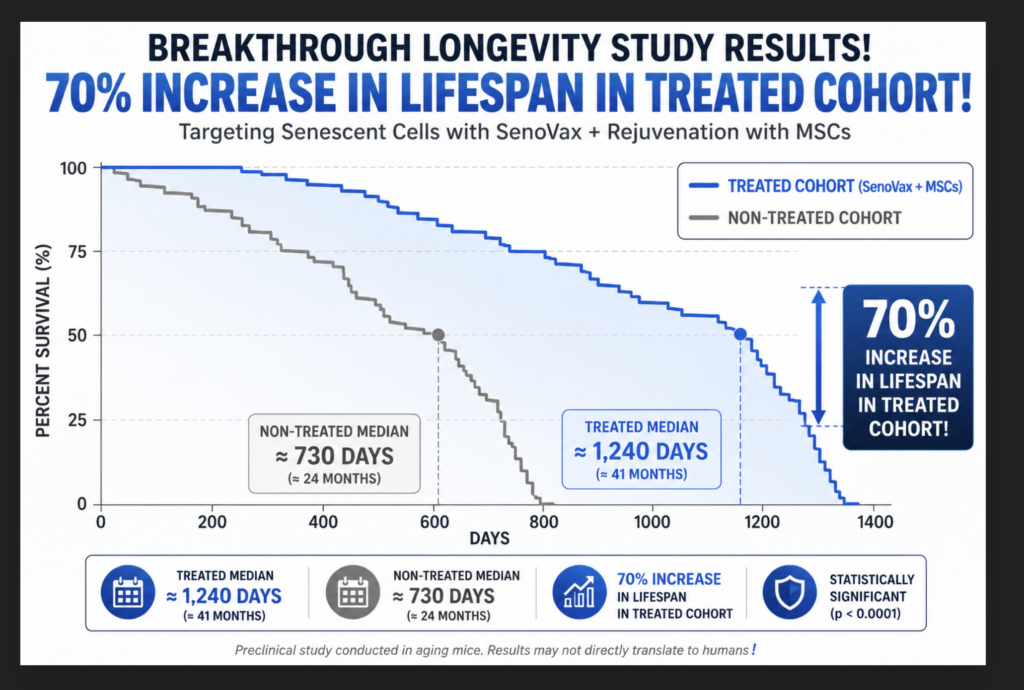
Breakthrough: CPI Scientists Increases Lifespan 70%
For decades, aging has been treated as an unavoidable fact of life.
What if it isn’t?
In a groundbreaking new study conducted by scientists from TAM Global, CPI, Immorta Bio, the Buck Institute for Research on Aging, Cedars-Sinai, University of Miami, UC San Diego, George Washington University, and other leading research organizations, a novel therapeutic approach increased lifespan by more than 70% in a preclinical model.
The results represent one of the most exciting developments in longevity science and support a growing belief among researchers around the world: aging itself may be a treatable biological condition.
The Real Enemy: Zombie Cells
As we age, damaged cells accumulate throughout the body.
Normally, these cells would be identified and removed by the immune system. However, some cells enter a dysfunctional state known as cellular senescence. These senescent cells stop functioning properly but refuse to die.
Scientists often refer to them as “zombie cells.”
Like zombies in a movie, they linger long after they should have been eliminated. Worse, they release inflammatory signals and toxic molecules that damage surrounding healthy tissue. Over time, these cells contribute to chronic inflammation, tissue dysfunction, immune decline, and many of the diseases commonly associated with aging.
Researchers increasingly believe that senescent cells are not simply a consequence of aging—they may be one of its primary drivers.
Teaching the Immune System to Hunt Aging
The first component of the therapy utilizes Immorta Bio’s proprietary SenoVax technology.
To understand how it works, it helps to understand one of the most important cells in the immune system: the dendritic cell.
Dendritic cells are often described as the “teachers” or “intelligence officers” of the immune system. Their job is to collect information about threats and present that information to other immune cells, teaching them what to attack.
Think of a dendritic cell as a detective assembling a wanted poster.
In this study, dendritic cells were programmed to recognize senescent-associated antigens. These antigens are unique molecular markers found on the surface of senescent cells. By exposing dendritic cells to these markers, researchers effectively trained the immune system to recognize zombie cells as targets.
Once activated, the immune system became far more efficient at identifying and eliminating these harmful aging cells throughout the body.
Instead of simply slowing symptoms, the approach attempts to address one of the biological root causes of aging itself.
The Second Step: Rebuilding What Time Has Damaged
Removing zombie cells is only half the equation.
After clearing senescent cells, researchers introduced mesenchymal stem cells (MSCs) to help restore damaged tissues and promote regeneration.
This creates a powerful one-two punch.
First, remove the biological drivers of dysfunction.
Then, support the body’s ability to repair itself.
According to TAM Global Chief Scientific Officer Dr. Francesco Marincola, eliminating senescent cells creates a more favorable biological environment for regeneration, allowing stem cells to function more effectively.
The concept is simple but powerful: clean up the damage, then rebuild.
Why This Matters
Most therapies in medicine focus on treating individual diseases after they appear.
Longevity science is different.
It seeks to identify the underlying biological processes that drive multiple diseases simultaneously.
The same mechanisms involved in aging are also implicated in cardiovascular disease, neurodegenerative disorders, metabolic disease, immune dysfunction, and cancer.
If scientists can successfully intervene in those fundamental mechanisms, the implications extend far beyond simply living longer.
They could potentially transform how humanity approaches chronic disease itself.
More Than Stem Cells
Many people know CPI for its pioneering work with mesenchymal stem cells.
What most people do not realize is that stem cells are only one component of a much larger scientific ecosystem.
TAM Global has built an integrated translational medicine platform spanning genomics, proteomics, digital pathology, cellular manufacturing, advanced diagnostics, and clinical research. With laboratories in Boston, Nashville, and Mexico, the organization combines discovery science, laboratory infrastructure, and clinical translation under one umbrella.
The result is a platform capable of moving advanced therapies from concept to clinic with extraordinary speed.
The Beginning of a New Era
The significance of this study extends beyond a single publication.
It demonstrates that aging can be targeted through precise biological interventions. It shows that the immune system can be trained to recognize and eliminate one of the fundamental drivers of age-related decline. And it provides evidence that combining immune reprogramming with regenerative medicine may unlock effects far greater than either approach alone.
While additional studies and future human trials remain ahead, the trajectory is becoming increasingly difficult to ignore.
For generations, humanity has accepted aging as an inevitability.
Today, some of the world’s leading scientists are beginning to ask a different question:
What if aging is simply the next disease we learn how to treat?